Archive for » December, 2012 «

The Bonding Process

As a Steampunk abstract artist of almost a year now, I have seen and marveled at some of the most creative, innovative and astoundingly beautiful works of handmade art that I have ever paid serious attention to. At many conventions, they are set up as a display, to purchase easily or for the admiring, but jealous folks to look on from afar and kick themselves for not bringing more money. Not to mention the many fantastic artisans that, quite a few of which, I get to call friends.

Now, most of the creative faces I know and love are phenomenal seamstresses, but I am also quite friendly with a large handful of painters, photographers, metal jewelry crafters, welders, carpenters, leather workers, etc. All are brilliant in their own mediums of expertise, as well.

But with a majority of the crafters I know and the many venders I have met during my somewhat limited experiences at the Steampunk Symposium and Teslacon, there is an unspoken, highly awkward subject matter that causes immediate internal unrest within the most confident artists who work mainly in metals and/or textiles: The excruciating realization that one sees on a detail-oriented customer’s face when they discover that the bonding agent used on the piece that caught their eye is GLUE, then setting the piece down with a look of quick disdain and a crap smile as the cherry on top.
Almost as if you tricked them with your ninja skills at making bad glue mistakes reappear, just for a laugh at their expense. . .

Well, maybe that’s a BIT exaggerated.

But there it is. That ugly distaste, or just a fake sympathetic look that when answered truthfully, and is very honestly the truth in a good many cases is

  1. An automatic demotion of the piece in question
  2. Your whole Etsy account teetering on the brink, and
  3. A very real possibility of con vendor room snubbery if that particular g-word gets around.

Sound far fetched or overly paranoid? You’d be surprised.

I’ll just come clean with you all now:
I WORK WITH GLUE AND I’M PROUD.

There. Now you know how I roll, just in case glue of any strength or bonding ability immediately turns your nose up. And that, of course, is just fine :)

I have worked in just about all mediums. Ever since winning a ribbon in first grade, I have barely stopped striving to conquer them all. Unfortunately the mediums that still allude me AND my levels of patience, are sewing and knitting. The one I all but refuse to attempt is soldering because of toxic fumes and the inevitable scarring of my person. So in the case of metal jewelry, and just recently, hat making, what other bonding choices are left that make sense? Why the massive stigma? Is there no artistic integrity in being very talented with a hot glue gun, or the painstaking process of mastering super glue? Is anyone AT ALL aware of the murderous plots that take shape while attempting to ‘learn as you go’?

As for me and my own personal opinion, it’s merely a matter of quality. If you are one of those with more meticulous tastes, needing to see stitch lines or a tiny watch gear soldered to an earring as proof of craftsmanship, have no fear, you are not alone. In truth, I reluctantly confess to the same prejudice in similar circumstances. Like most artists, it is unavoidable due to our overly scrutinizing eye for detail and perfection, a flaw I would gladly be rid of.

As for the untrained eyes that praise your pretty trinkets and buy them on looks alone? All you can ever hope for is that the splendor they beamed at (enough to purchase from you), and in turn, gave YOU the surge of joy from seeing the purest example of the reasoning behind the tears and heartache. . .
All you can hope, is that your vision performs as promised, and that hopefully someone noticed.

But, of course, that’s just me and mine….
LIONWHOLE

Category: Makers  3 Comments

Guest Author: Leanna Renee Hieber

shapeimage_1Author, actress and playwright Leanna Renee Hieber grew up in rural Ohio inventing ghost stories. She graduated with a BFA in Theatre and a focus in the Victorian Era from Miami University. She began her theatrical career with the Cincinnati Shakespeare Company and began adapting works of 19th Century literature for the stage. Her one-act plays such asFavorite Lady have been published, awarded and produced around the country. Her novella Dark Nest won the 2009 Prism Award for excellence in the genre of Futuristic, Fantasy, or Paranormal Romance.

Her debut novel, The Strangely Beautiful Tale of Miss Percy Parker, first in her Strangely Beautiful series, landed on Barnes & Noble’s bestseller lists, was named a favourite of 2009 by 14 book blogs, won two 2010 Prism Awards (Best Fantasy, Best First Book), the 2010 Orange County Book Buyer’s Best Award (Young Adult category) and is currently in development as a musical theatre production with Broadway talent on board. The Perilous Prophecy of Guard and Goddess, the prequel in the series, won the 2012 Prism Award (Best Fantasy).

DARKER STILL: A Novel of Magic Most Foul, first in Leanna’s Gothic Historical Paranormal saga for teens (Sourcebooks), hit the Kid’s/YA INDIE NEXT LIST as a recommended title by the American Booksellers Association. The book has been praised by Seventeen Magazine, Shelf Awareness, The Chicago Tribune, Pixie Magazine and more and was selected for a SCHOLASTIC edition as a “highly recommended” title.

Leanna’s short fiction has been featured in anthologiesCandle In the Attic Window and the upcoming Willful Impropriety: Tales of Society and Scandal, ”Too Fond”; a short story on Tor.com and Queen Victoria’s Book of Spells: Tales of Gaslight Fantasy (March 2013, Tor). Her new Gaslamp Fantasy series with Tor/Macmillan, THE ETERNA FILES, launches 2014. Her books have been translated into many languages and have been selected for multiple book club editions.

Represented by Nicholas Roman Lewis, Leanna is a member of the Science Fiction and Fantasy Writers of America, Romance Writers of America and International Thriller Writers. She is proud to be a co-founder of the original Lady Jane’s Salon Reading Series in New York. Leanna was named the 2010 RWA NYC Chapter Author of the Year.

A member of Actors Equity Association and SAG-AFTRA, Leanna works often in film and television on shows like Boardwalk Empire. When not writing or on set, she’s busy telling ghost stories, frequenting Goth clubs, corset shopping, channeling Narcissa Malfoy, wandering graveyards and generally adventuring about her adopted hometown of New York City, where she resides with her real-life hero and their beloved rescued lab rabbit. She tweets avidly@leannarenee.

So you want to build a (remote control) dirigible?

If you were not in attendance for the first annual Steampunk Empire Symposium, you didn’t get to see the first “Airship Races” which were billed as the premier event in the Symposium Games. This first “running of the dirigibles” consisted of 5 remote control helium filled dirigibles with seemingly drunk pilots and one slow moving but well piloted clown fish to keep the dirigible pilots humble. It wasn’t the most exciting of RACES, and the pilots didn’t really navigate as much as they meandered, but damn it was fun to watch and to participate in. (VIDEO) Those of us who designed, built and piloted the first dirigibles in the inaugural Symposium games are surely now preparing for the next Symposium with new ideas, new designs, and hopefully, more practiced pilots. (wink wink, nudge nudge) In FACT, the 2012 winner of the RC dirigible design prize has told me they are planning to enter THREE RC dirigibles this year.

This post is intended to get as many entries into the 2013 Symposium Dirigible Races as possible.
I plan to give as much info and ideas as I can to help Airships and Groups get into the RC Dirigible hobby as possible. As a side note, you may notice I am using the term “Dirigible” a lot. I’m not just trying to be a terminology snob, there is a purpose for this. You see in the Steampunk community, the term “Airship” is commonly used to describe a group of Steampunks who fly under a common flag. The term Airship has become almost synonymous with “Airship Crew”. For this reason, I will always be using the term Dirigible to describe an actual physical flying vessel (be it real world or remote control).

To start off I’ll provide a link to the 2013 Dirigible Races Rules. This PDF has a lot of information you’ll want to know before you begin building an RC Dirigible for the Symposium games, such as info on RC transmitter types and physical size limits for your dirigible. BUT, because I know that link barrier will often deter someone from going any further, I’ll press on, with more detailed info on how to build an RC Dirigible.

The first and easiest option is of course, to buy a “ready to fly” remote control blimp. There are a few options out there, but the only well known and easy to find option is the Dragonfly Innovations Mach III blimps from RCToys.com. Two of last year’s entries were based on the Mach III blimps. They didn’t do to well on the navigation front, but that’s because the venue last year had a VERY BREEZY and large room. This year the room we use will be smaller and have less turbulence, which should make flying the Mach IIIs much easier. Concerning the Mach III blimps, if you are planning to do any physical modifications of the blimp’s gondola (which is what I did last year) you will want to get the “High Lift” model blimp. The high lift model has an envelope (balloon) that allows you to add more weight to the gondola and still have it achieve neutral buoyancy. If you just want to paint the gondola, the high lift model is likely not necessary. I recommend getting a spare envelope, regardless of which model you choose, just in case.

Tf you are more adventurous, you could try any number of other ways to build one from scratch, or to use other existing remote control products that AREN’T dirigibles, and turn them into dirigibles.

Last year we had a completely scratch built dirigible and another dirigible that was a combination of scratch made materials. This full scratch built dirigible was made up of hobby grade electronics and was by far the most POWERFUL of the dirigibles. It is beyond my ability to describe how one should go about building one that way without a whole series of detailed posts on the subject. Hobby grade equipment can be a complicated subject to discuss with laymen.

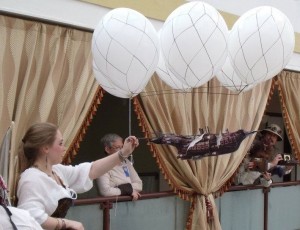
However, there was also another custom Dirigible last year. This Dirigible, named “Her Majesty’s Airship Omnipotent of the Unspeakable Empire of Cheviot”, was made by integrating a twin prop flying toy with a custom designed printed vinyl dirigible frame, and suspending it from a six pack of white helium balloons. The designer provided the craft with a slightly negative buoyancy (it slowly sank when not under power), and the twin props would make the ship rise and move forward, thanks to the mechanics provided by the rigging, and the remote control allowed them to vary the speed of each of the two props, to allow for steering. See a close up video of this dirigible HERE

There are a large number of very light flying toys, that consist of a styrofoam airplane with either double or single electric remote control propellers. There are also a number of hovercraft type RC vehicles that could be used as “powerplants” for a dirigible. Finding the right flying toy, with the right rigging and custom framing to achieve a navigable helium lift dirigible, is the challenge. Keep in mind that you can use slightly negative buoyancy with some designs, meaning if done right, it doesn’t need to be able to free float. (a helium lift mechanism is required, no plain helicopters or quad copters)

I personally have been toying with the idea of using two (or maybe three) small flying toys in one dirigible. Meaning you would need multiple crew members to fly it. One to run the steering toy, one to run the “engine room” toy, and maybe even one to handle elevation. It would be like flying a real ship where you have to call out “FULL SPEED AHEAD” to your engine room. How cool would that be? The only problem there is finding flying toys that don’t interfere with each other. Perhaps a 27mhz for one, and an infra red for the other. (see the rules document above for more on transmitter types and frequency issues)

One other, possibly more simple custom option, is to take the control mechanisms from a flying fish, flying shark or flying dolphin toy (which usually consists of a flapping tail fin and a prop for steering) and integrating them into a less animal shaped, and more dirigible themed floating vessel, perhaps making the tail fin into more of a flapping silk sail on the back of a dragonfly innovations envelope/balloon. I must point out, that “stock” out of the box flying animal toys will be frowned upon for entry in the races. Bring them if you like, but please don’t enter them in the competition as a “dirigible”.

The last bit I have to say is that if you DO want to buy, build or modify an RC dirigible, you need to buy your helium tanks now. Helium is going back and forth with availability, and you’ll want to make sure you have the helium you need well before the symposium.

Also, MAKE SURE your Airship or group is registered with the Symposium Games (details coming soon) AND that your RC Dirigible is registered with the Dirigible Races Organizer (me)
My contact email can be found in the rules document linked above, or you can contact me at The Clan of Teks Facebook community.